Rain Scent Accord with Vetiver: A Diffuser Blend by Parts
There is a smell that arrives just before a storm, when dry ground meets the first drops of rain, and almost everyone recognises it. Perfumers have been chasing it for a very long time, and vetiver is one of the first materials they reach for. Jean-Paul Guerlain's Vetiver of 1959, the Osmothèque says, was meant to evoke earthiness after rain, and Dior's Eau Sauvage uses a woody vetiver note that evokes damp undergrowth (Vetiver : a palette of woody fragrances, Osmothèque). This page builds a small diffuser accord on the same idea.
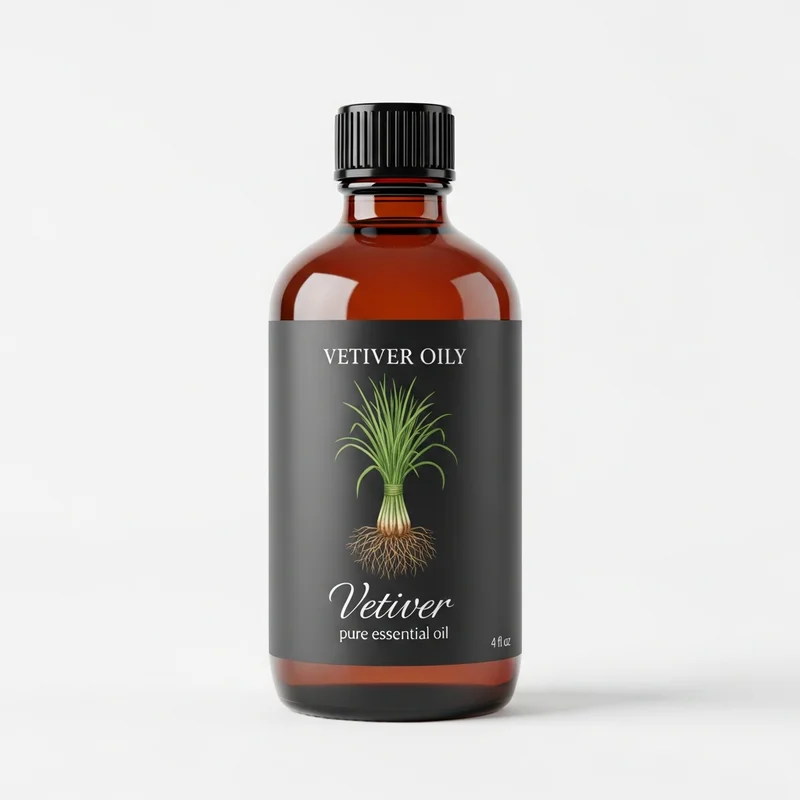
Vetiver Essential Oil
Our own Vetiver Essential Oil, in sizes from 0.5 oz to bulk.
From $20.99
Shop Now →Where the smell of rain comes from
The word for it, petrichor, was coined by two Australian scientists, Isabel (Joy) Bear and Richard Thomas of CSIRO, in a 1964 paper in Nature. They steam-distilled rocks that had been exposed to warm, dry conditions and obtained a yellowish oil that was released by moisture and responsible for the smell. CSIRO adds a lovely detail: a small perfumery industry in India had already captured the scent in sandalwood oil, calling it "matti ka attar", or earth perfume (The smell of rain: how our scientists invented a new word, CSIRO). How the smell gets into the air is a separate question. MIT researchers ran roughly 600 experiments on 28 surfaces, including 16 soils, and found that raindrops on porous surfaces release aerosols; one of the researchers described the link to the smell as a hypothesis (Rainfall can release aerosols, study finds, MIT News).
None of that tells us which molecules to put in a bottle, and no source we read links vetiver's chemistry directly to petrichor. The case for vetiver is the perfumer's one, an aroma analogy: earthy, damp and rooty. That is a judgment for your own nose.
What vetiver already brings
A 2021 study of Haitian vetiver oil reports that its earthy side comes from geosmin, with a little help from nor-acorenone, and that alpha-vetivone, beta-vetivone and nootkatone give a grapefruit-like top. The key odorant, a trace ketone detectable at 29 picograms per litre of air, supplies the woody-ambery heart (Ouyang et al., The Smelling Principle of Vetiver Oil, Unveiled by Chemical Synthesis). That was one sample in one study and not our own oil, but it makes the design logic clear. Vetiver on its own already travels from a fresh top to a damp-earth base, so a rain accord only needs two companions: something dry and woody so the earth does not turn muddy, and something bright so the opening does not feel heavy. That is our design reasoning, and you should trust your nose over our ratios.

A three-oil concentrate, worked out in parts
This is a 10 ml diffuser concentrate, with no carrier and no water, built from arithmetic and the logic above. We sell vetiver only, so the other two come from an essential-oil supplier.
- Vetiver: 5 parts, 5 ml. On the batch our Certificate of Analysis covers, relative density is 0.993, so 5 ml weighs about 4.97 g.
- Cedarwood: 3 parts, 3 ml, for the dry woody lift. Choose one whose species and safety data you have read.
- Bergamot FCF (furocoumarin-free): 2 parts, 2 ml, for brightness. The Tisserand Institute says bergamot FCF is not phototoxic, a point that matters if you later use the blend on skin (Citruses: a comparison of different oils, Tisserand Institute).
- Pour the bergamot into a clean glass bottle first, then the cedarwood, then the vetiver, so the thick oil goes in last.
- Weigh if you can. Vetiver clings to pipettes, so rinse or scrape the tool into the bottle.
- Cap, label with the date and each oil, and let it sit for a few days before judging.
- Smell it on a blotter. If it feels heavy, try 4 parts vetiver and 3 bergamot. Treat these ratios as a starting point.
For the scent of vetiver itself, our scent guide is a helpful companion.
Smell the pieces before you mix
Before you pour anything together, put each oil on its own blotter strip and label the strips in pencil. Smell them one at a time, then hold two together and then all three. You will quickly hear what each one is doing: the vetiver deep and smoky-sweet, the cedarwood dry, the bergamot bright. It is a lovely way to spend ten minutes, and it makes your adjustments much better informed than guessing from the bottle.
Then let the weather help. Next time a storm is coming, open a window, notice what the air smells like, and compare it with your strip. Your nose is the judge here, and there is no wrong answer.
Using it
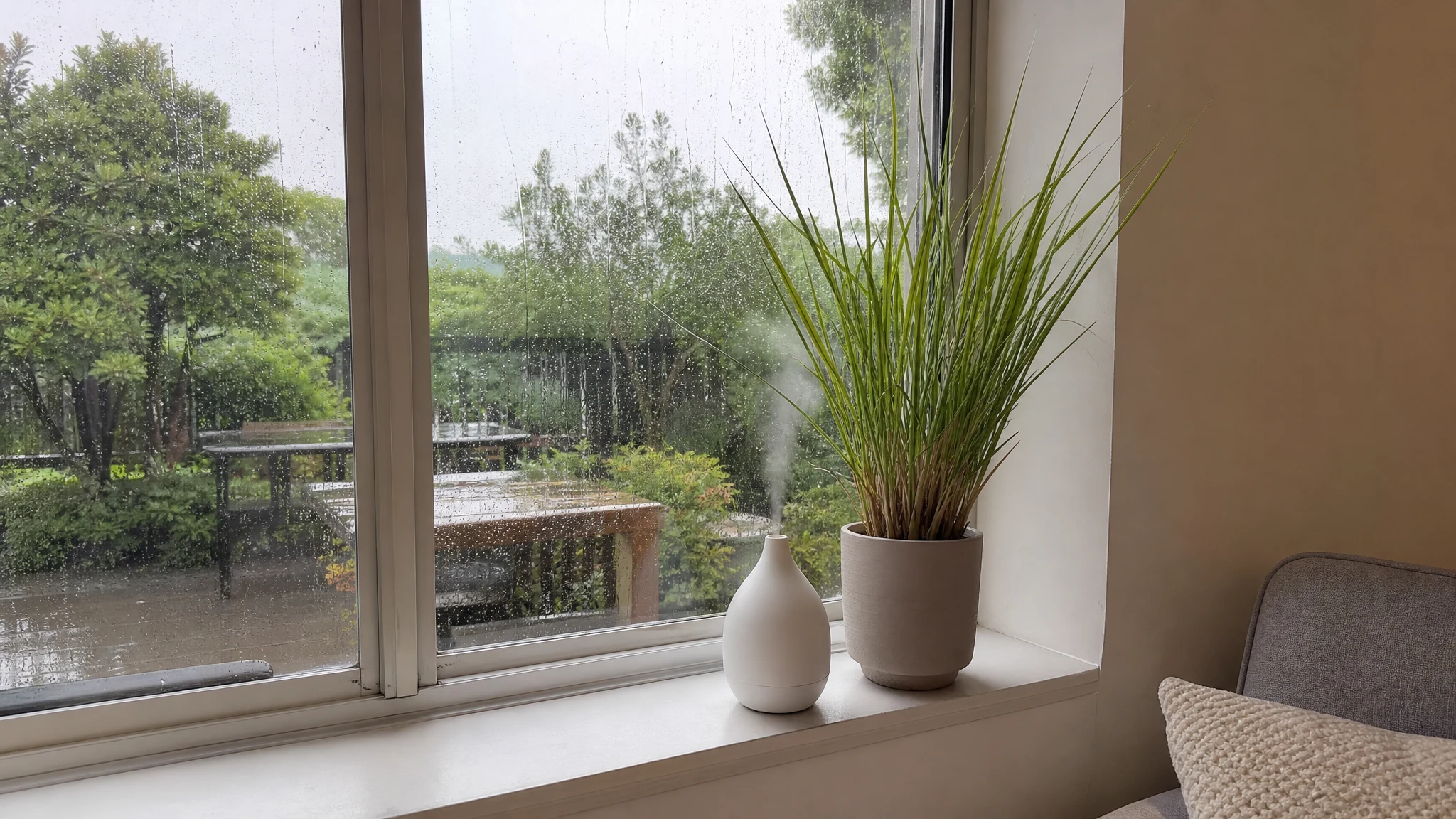
In a diffuser, begin with very little. The Tisserand Institute defines intermittent diffusion as 30 to 60 minutes on, then 30 to 60 minutes off, and says very low levels, barely noticeable, are fine for any length of time (Safety guidelines for diffusing essential oils at home, Tisserand Institute). Two or three drops of the concentrate is our suggested starting point, not a sourced dose. Thick oils behave differently in different devices, which our diffuser guide explains. If pets share the home, ask a veterinarian about your particular animal.
On skin, the arithmetic leaves little room. Our guidance for vetiver is 0.5% to 2% in a carrier, with a patch test first. A 10 ml roller bottle at 1% holds 0.1 ml of this concentrate, about two drops, so a worn version is better made through a proper perfume formula; see making a vetiver perfume at home.
Rain accords divide people, and a vetiver-heavy one may smell more like a root cellar than a storm. That is part of the fun, and the right ratio is the one you reach for again.
Vetiver Essential Oil
Vetiver Essential Oil from our own shop, in sizes from 0.5 oz to bulk.
From $20.99
Shop Now →Sources & Further Reading
- Vetiver : a palette of woody fragrances (Osmothèque, 2015)
- The smell of rain: how our scientists invented a new word (CSIRO, 2015)
- Rainfall can release aerosols, study finds (MIT News, 2015)
- The Smelling Principle of Vetiver Oil, Unveiled by Chemical Synthesis (Ouyang et al., Angewandte Chemie, 2021)
- Citruses: a comparison of different oils (Tisserand Institute)
- Safety guidelines for diffusing essential oils at home (Tisserand Institute)