Vetiver Oil and Termites: What Lab Studies Found
It is one of the most repeated lines about vetiver: it keeps termites away. The line has a real origin. Researchers in Louisiana tested vetiver oil on Formosan subterranean termites and saw striking effects. What they tested, though, was quite different from a few drops on a cotton ball, and that difference is the interesting part of the story.
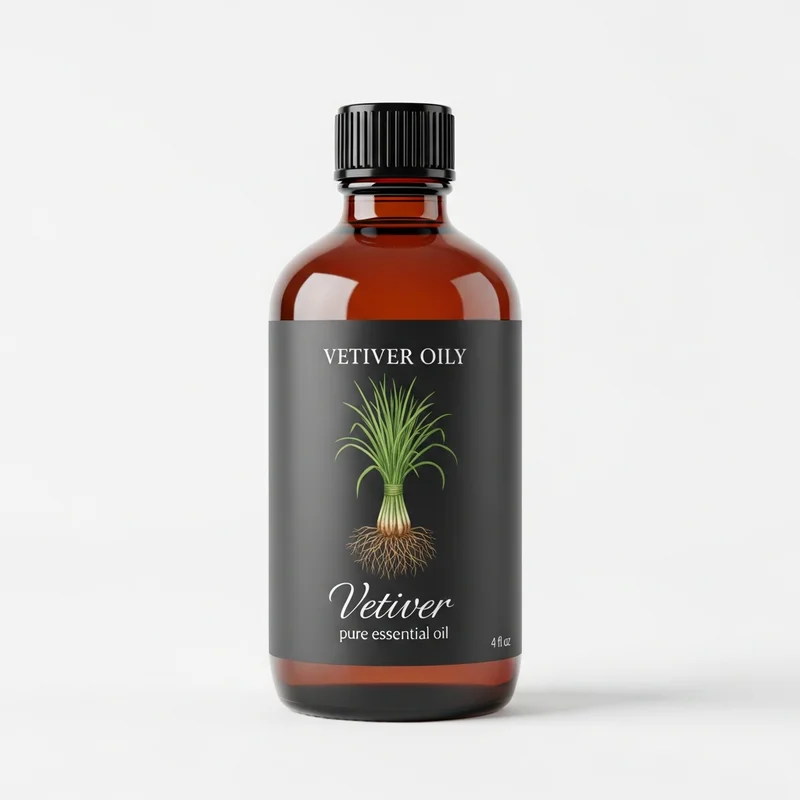
Vetiver Essential Oil
Our own Vetiver Essential Oil, in sizes from 0.5 oz to bulk.
From $20.99
Shop Now →What the studies actually did
The research comes from one group working with the Formosan termite, Coptotermes formosanus. In 2001 they reported that nootkatone, a compound isolated from vetiver oil, was a strong repellent and toxicant, effective down to 10 micrograms per gram of material. It was the first report of nootkatone repelling insects. Later in 2001 the same group put vetiver oil, nootkatone and cedrene into sand that termites had to tunnel through to reach food. Sand treated with vetiver oil or nootkatone disrupted tunnelling, and after 21 days wood consumption and termite survival were significantly lower than with cedrene or plain sand. At 100 micrograms per gram of sand, both worked as barriers.
A 2003 paper treated wood slices with a 10 g per litre solution and tracked them over a year, comparing vetiver oil, nootkatone and a borate lumber preservative. Vetiver oil and nootkatone limited tunnelling and feeding, and nootkatone's effect lasted 12 months, longer than the oil's. When termites could choose, they preferred untreated wood. The authors concluded that vetiver oil and especially nootkatone acted as arrestants and repellents, while the borate was toxic but not repellent.
Two things stand out. The strongest, longest-lasting effect belonged to a single compound, nootkatone, rather than to the whole oil. And the oil was mixed into the material the termites touched or ate, which is a very particular kind of exposure.
From a lab dish to a house
Reasoning from those designs, a diffuser, a scented cloth in a cupboard or a spray on a baseboard puts oil in a very different place from sand mixed with oil or wood soaked in a solution, and none of the papers tested those. The setting was small laboratory enclosures with one termite species, while real colonies are large, hidden and often underground. The choice test also points to a practical limit: termites moved toward untreated wood. A treated board may simply send them to the next one, which is not the same as protecting a structure.
Vetiver oil is also a mixture of hundreds of compounds, as chemists who have worked on it describe, and the proportion of any one compound varies from oil to oil. We do not publish composition data for our oil, so we cannot tell you how much nootkatone a bottle holds.
What the EPA says
The EPA's termite guidance is blunt. Termiticide treatments can contaminate the home and nearby drinking-water wells and will not protect against termites if done improperly, so it advises hiring a licensed, trained pest management professional. It also notes that products which only claim to kill termites on contact have not demonstrated that they protect a structure. By that logic, an oil that killed termites on contact would still not be protection for your home.
The EPA's registration of nootkatone as a new active ingredient in August 2020, for use in insecticides and insect repellents, shows how seriously this compound is taken, and that it is being developed as a proper registered product. If you are thinking of selling anything with a pest claim on it, the EPA's page on personal insect repellents and minimum risk pesticides is the place to start, and your state may have its own rules.
If you suspect termites
- Probe exposed wood with a flathead screwdriver for hollow spots. Swarming termites have wings of roughly equal length and straight antennae, while ants have longer front wings and bent antennae.
- Call a licensed pest professional, and ask to see the licence. The EPA says firms offering termite services must be licensed by your state.
- Work on the conditions: keep soil near the foundation dry, fix leaks, seal cracks, and keep firewood away from the house.
Where vetiver oil belongs
We sell vetiver for its aroma and for cosmetic use, steam-distilled from roots, deep and earthy. That is where we recommend it, in a diffuser blend, a diluted skin oil or a homemade fragrance, with our guidance of 0.5% to 2% in a carrier oil and a patch test before it goes on skin. We make no pest-control claim for it. For biting insects, read our insect repellent post. The oil's journey from root to bottle is in the extraction post, the basics are in what vetiver oil is, and the rules for skin are in the dilution guide.
A simple pleasure instead
If the termite story has left you wanting something to do with the bottle, here is a gentler idea. Put a drop of diluted blend on a card or a cotton pad and tuck it into a drawer or a small cloth sachet, away from anything that could stain. The scent is deep, earthy and smoky-sweet, and it can make a drawer smell like a warm, quiet forest. Treat it purely as a fragrance, and replace the card when the smell fades.
Keep the bottle itself in good shape, too. Store it sealed in a cool, dark place, wipe the neck after pouring so it does not get sticky, and keep it away from children and pets. On shelf life, we say it typically retains its character for 6 to 8 years stored that way, which gives you plenty of time to discover what you like to do with it.
The termite results are a genuine curiosity of plant chemistry and a lead for researchers. For your home, the answer is still a licensed professional and a dry foundation.
Vetiver Essential Oil
Vetiver Essential Oil from our own shop, in sizes from 0.5 oz to bulk.
From $20.99
Shop Now →Sources & Further Reading
- Zhu BC et al., 2001: Nootkatone is a repellent for Formosan subterranean termite (Coptotermes formosanus)
- Maistrello L, Henderson G, Laine RA, 2001: Efficacy of vetiver oil and nootkatone as soil barriers against Formosan subterranean termite (Isoptera: Rhinotermitidae)
- Maistrello L, Henderson G, Laine RA, 2003: Comparative effects of vetiver oil, nootkatone and disodium octaborate tetrahydrate on Coptotermes formosanus and its symbiotic fauna
- Ouyang J et al., 2021: The Smelling Principle of Vetiver Oil, Unveiled by Chemical Synthesis
- US EPA: Termites: How to Identify and Control Them
- US EPA: Nootkatone Now Registered by EPA
- US EPA: Personal Insect Repellents and Minimum Risk Pesticides