Is Thicker Vetiver Oil Better? What the Pour Tells You
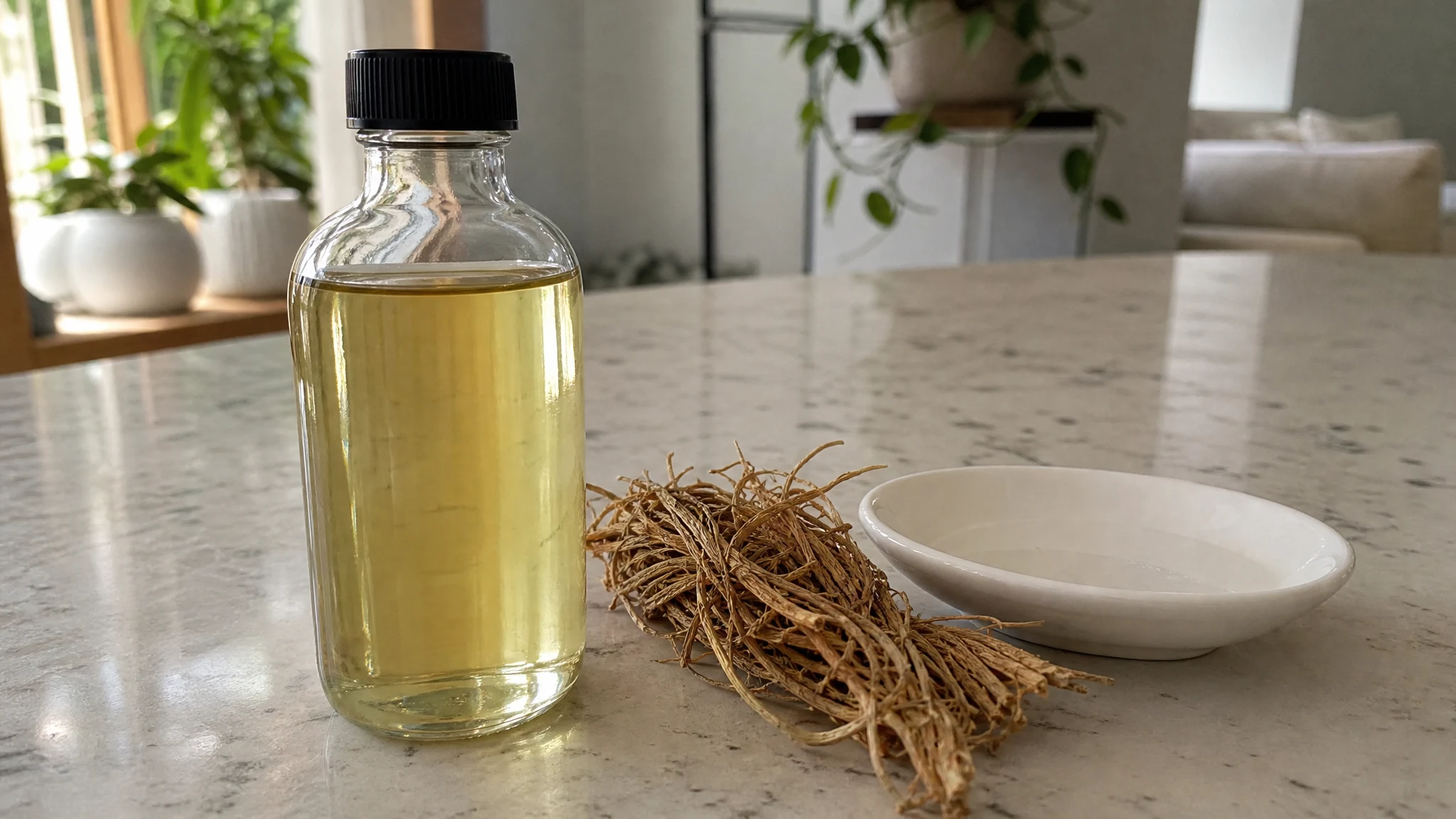
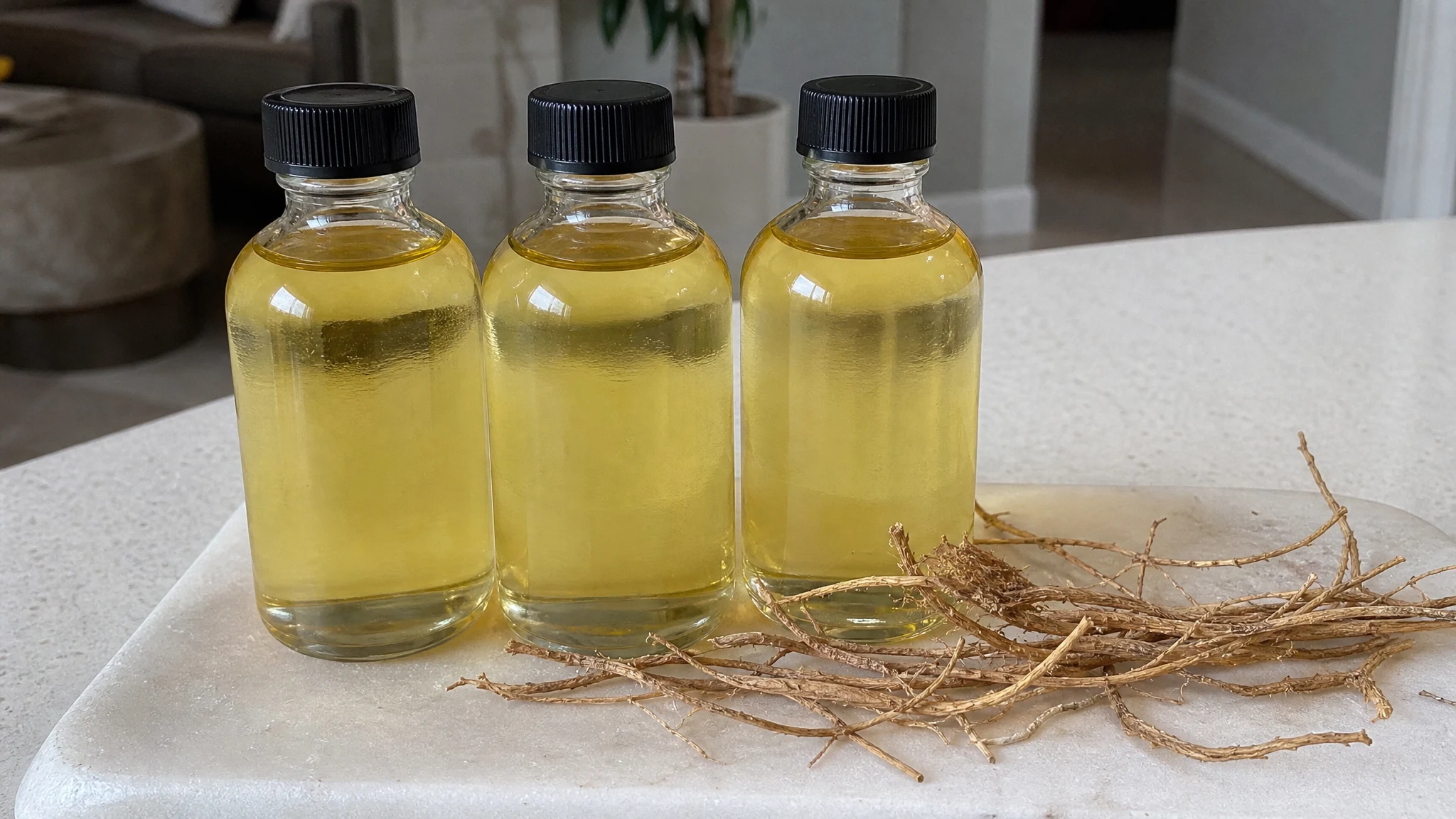
Tip a bottle of vetiver and watch it crawl. It is one of the most satisfying things about the oil, and it has led to a popular rule of thumb: the thicker the pour, the better the oil. We describe our own vetiver as thick and slow-pouring, so we are not about to call that a flaw. But as a way of judging quality, the pour tells you less than you might think.
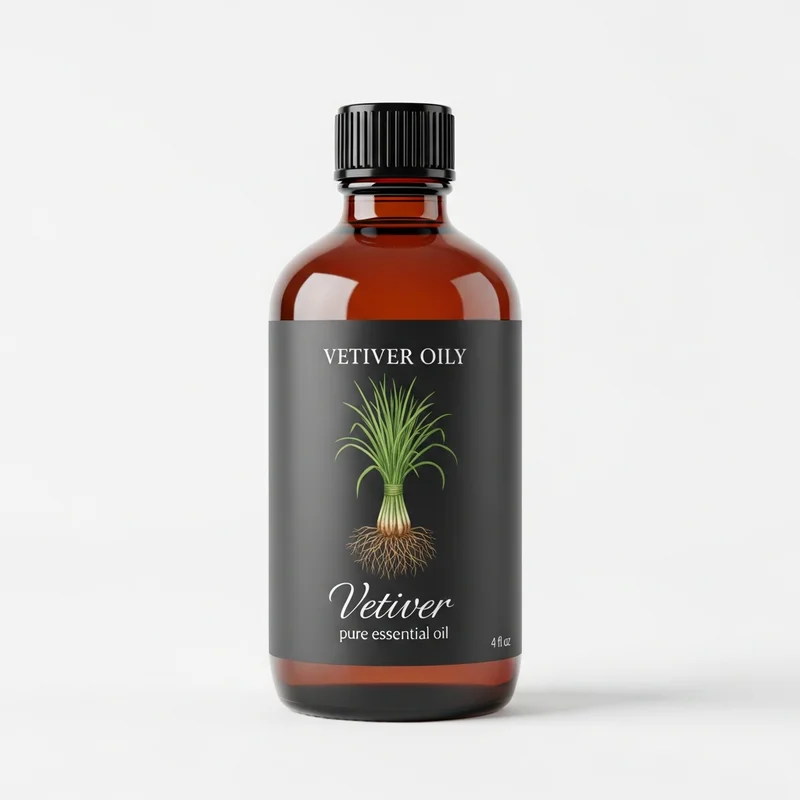
Vetiver Essential Oil
Our own Vetiver Essential Oil, in sizes from 0.5 oz to bulk.
From $20.99
Shop Now →What the pour is really showing you
Viscosity is simply how a liquid resists flowing, and it changes with temperature. The same bottle pours slowly from a cool shelf and more freely from a warm kitchen counter. That is one reason we suggest warming the bottle in your hands, or in a cup of warm water, before you measure it. By reasoning from basic physics, a slow pour on a cold day and a quicker pour on a warm one are the same oil.
The formal standard for vetiver oil, ISO 4716, does not run on feel either. According to its catalogue entry, it covers oils from Réunion, China, Haiti, Indonesia, Madagascar, Brazil and the Comoros, and sets limits at 20 C for relative density, refractive index, optical rotation and acid value, with the numbers depending on origin. The standard itself is paywalled and we have only read the catalogue summary, but that is enough to see the approach: quality is measured values compared with a range, not a gut impression of syrupiness.
Time makes vetiver thicker
The most useful evidence we know of comes from a storage study. Researchers kept a South Indian vetiver oil for 6 to 30 months and found that viscosity, specific gravity and refractive index all rose over that period. At the same time the smell shifted from sharp, green and harsh toward something softer, sweeter and more balsamic, as some compounds increased and others, including khusimol, fell.
That is worth sitting with. It means thickness partly records how long an oil has rested, and in that study the thicker oil was also the one with the more mellow smell. So a thick bottle can mean "settled", which many perfumers love. It can also just mean "cool", or something else. The pour alone cannot tell you which. This is one oil from one region, so we would not turn it into a rule for every bottle.
Thickness and scent are separate things
Here is another reason the pour is a blunt tool. Analysis of a Haitian vetiver oil shows it is made of several hundred sesquiterpene derivatives, and the heavy, sticky character comes from that whole crowd of large molecules. The smell, on the other hand, rides on a few compounds present in tiny amounts, with one of them detectable at 29 picograms per liter of air. We explain that in our chemistry article. Viscosity belongs to the crowd, and aroma belongs to the few, so a bottle can be thick and still smell off, or pour a touch freer and smell wonderful.
What we would check instead
When someone asks us how to judge a bottle, we point them to a short list.
- The name and the part. The label should name the plant and say root. Our Certificate of Analysis lists "Vetiveria zizanioides (Vetiver) Root Oil", parts used root, steam distilled.
- Measured values for the lot. The certificate we publish covers one batch and lists relative density 0.993 at 20 C (printed standard 0.985 to 1.020) and refractive index 1.525 (1.520 to 1.528). If you need optical rotation, acid value or a GC-MS report, ask us in writing through our contact page for the report for your lot.
- The smell over hours. Put a drop on a paper blotter and come back to it after a few hours. The top fades first and the base remains.
For more on the whole process, see our guide to judging a bottle.
A small ritual for a slow oil
We have come to like the pace this oil sets. Before you pour, give the bottle a minute in your hands or in a cup of warm water. Tilt it over a small dish or a clean pipette and let it come to you instead of shaking it out. Watch the thread of oil stretch and fall. It is a quiet little moment in a busy day, and it reminds you to measure carefully instead of rushing.

Afterward, wipe the neck of the bottle with a paper towel so it does not get sticky, and cap it firmly. You will notice that a thick oil clings to everything it touches, including the pipette, so leave it a moment to drain. If you ever find yourself in a cool room and the oil seems stubborn, that is simply the temperature talking, and warming it a little makes everything easier.
Keep a few paper towels and a small dish near your workspace, and measure over the dish so a stray drip never reaches the table. That one habit saves more cleaning than any trick we know.
Where thickness helps you
It is useful in practice. A thick oil is easy to see and slow to run, and a little goes a very long way. Because drops are large, we suggest a pipette or a small scale for blending, and a quick warm-up of the bottle before you pour. Then enjoy the slow, honeyed flow. It is part of the charm.
Vetiver Essential Oil
Vetiver Essential Oil from our own shop, in sizes from 0.5 oz to bulk.
From $20.99
Shop Now →Sources & Further Reading
- Dubey, Chhonkar and Raghav, Effect of Period of Storage on Physico-chemical Properties and Major Constituents of South Indian Vetiver (Vetiveria zizanioides Linn.) Oil (Indian Forester, 2011)
- Ouyang et al., The Smelling Principle of Vetiver Oil, Unveiled by Chemical Synthesis (Angewandte Chemie, 2021)
- ISO 4716:2013 - Vetiver Essential Oil Quality and Testing Standard (iTeh Standards catalogue)