5 Vetiver Oil Claims, and How to Check Each One
Vetiver is a magnet for big claims. It is rare-sounding, dark and mysterious, and it has a past as a perfume legend, which makes it easy to wrap in secret grades, exclusive molecules and drug-like promises. Most of those claims dissolve when you ask one simple thing: what document stands behind that? Here are five that come up often, and how to test each one.
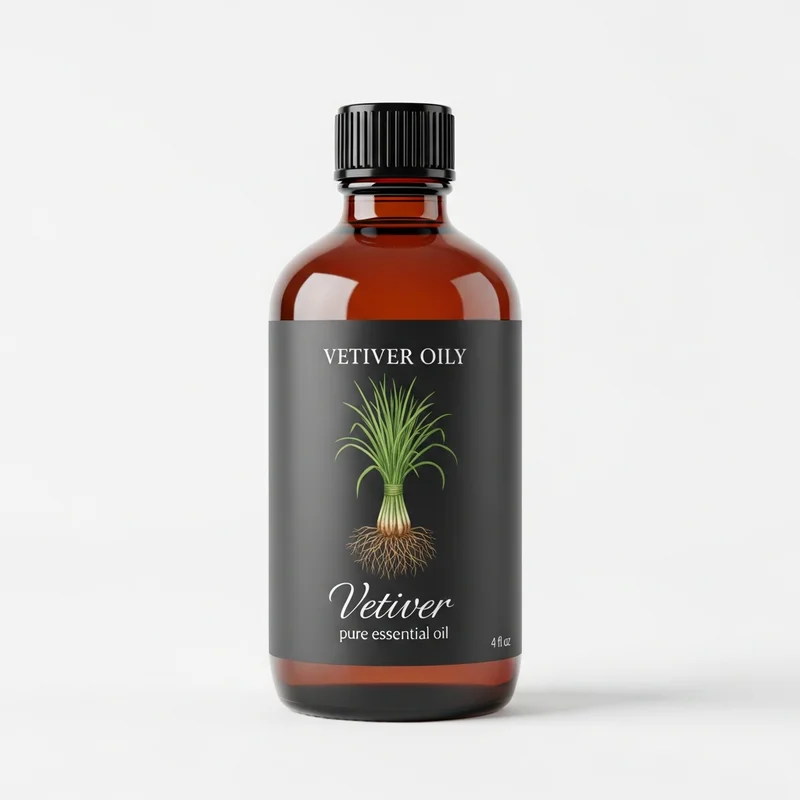
Vetiver Essential Oil
Our own Vetiver Essential Oil, in sizes from 0.5 oz to bulk.
From $20.99
Shop Now →"Therapeutic-grade" means a better oil
The phrase sounds official, but it is not an independent standard. Robert Tisserand, a long-standing aromatherapy author, wrote in 2010 that terms such as pharmaceutical grade, therapeutic-grade or food grade have no meaning for aromatherapy oil quality, and that there is no independent, industry standard known as "therapeutic-grade" (Therapeutic-grade oils - read all about it!, Robert Tisserand). In the reader comments he adds that ISO standards do exist for many essential oils. That is a useful distinction. A standard such as ISO 4716 describes what a well-made vetiver oil measures, and says nothing about what the oil does to a person. A grade word the seller invented for itself shows the seller's opinion, not a test result.
"It can ease or support" something
Regulators read health claims seriously. In June 2022 the FDA sent a warning letter to a direct-selling essential oil company after reviewing its website and the social media accounts of several of its independent consultants. The agency said claims such as "May reduce inflammation" for lemon oil and a frankincense claim about urinary tract infections showed the products were intended for use against disease, and that it was not aware of adequate, well-controlled clinical studies supporting them (Young Living Essential Oils Corporate - 615777 - 06/10/2022, FDA). The letter did not name vetiver. The lesson carries over, though: what a seller says is judged by labelling, advertising and the circumstances of sale, including what its representatives post. That is why we make no sleep, calming, focus or other health claim for our oil, and why our pages on sleep and anxiety describe what studies tested and not what an oil does.
"Our vetiver has compounds yours does not"
Vetiver oil is chemically crowded, which makes secret-compound language easy to say and hard to check. A 2021 paper from team at the Max-Planck-Institut für Kohlenforschung, working with a Haitian oil, describes it as a complex mixture of hundreds of molecules, of which only 155 had been identified. Khusimone, long proposed as the smelling principle, makes up about 2% of the oil but has an odour threshold of 4.7 ng per litre of air. A different trace ketone, detectable at 29 picograms per litre, more than 150 times lower, turned out to be the key odorant (Ouyang et al., The Smelling Principle of Vetiver Oil, Unveiled by Chemical Synthesis).
Two things follow, and both are our reasoning from the paper. A seller who names one marker compound as the reason its vetiver is special may be naming a molecule that is not what you smell. And since the same paper says about 60% of the world's vetiver oil comes from the Les Cayes commune of Haiti, "exclusive Haitian vetiver" is a thin distinction. Origin is a starting fact. For more, our article on vetiver chemistry goes deeper.
"A lab report proves it"
A lot-specific gas chromatography-mass spectrometry (GC-MS) report is a good thing to ask for, and it is worth knowing what it is. It lists what was measured in one lot, by one lab, on one date. It does not say whether the oil does anything for anyone, and it works best alongside simple physical checks. A generic report with no lot number, lab name or date deserves the same questions as any unsupported badge.
Here is what we can offer. The Certificate of Analysis we publish covers one batch and gives relative density of 0.993 at 20 °C (the printed standard is 0.985 to 1.020) and refractive index of 1.525 at 20 °C (standard 1.520 to 1.528), with appearance and smell both marked as complying. It does not include GC-MS data or optical rotation. If you need a composition report for the lot you are buying, ask us in writing through the contact page and read the report you receive before relying on it. Our guide to judging a bottle has more.
"Clinically studied"
The accurate version is narrower. A 2025 review of vetiver's medicinal literature covers in vitro, cell-line and animal work plus available clinical studies, and its authors say the evidence increasingly supports traditional claims; the abstract does not say how many human studies there are or how large (Gunasekar et al., Pharmacological and Therapeutic Potential of Chrysopogon zizanioides (Vetiver): A Comprehensive Review of Its Medicinal Applications and Future Prospects). A 2017 laboratory study of three commercial oils concluded that vetiver oil shows no particularly significant and innovative cosmetic value apart from its scent (Burger et al., Vetiver Essential Oil in Cosmetics: What Is New?). A seller who says "studies" should be able to tell you which oil, which route, which species, how many subjects and who paid for it.
A quick way to read a product page
Next time you read a listing, try a small exercise. Highlight every sentence that describes what the oil smells like, and every sentence that describes what it will do to you. The first set you can check with your own nose. The second set is where the questions belong. If the page is mostly the second kind, it is worth reading slowly.
Look for specifics: a batch number, a measured value, a date. Be wary of phrases that sound rich but give you nothing to hold, such as "premium," "exclusive" or "grade A." Words are cheap, and a number you can ask about is harder to fake.
What we would rather you did
We would rather you asked us a direct question and got a plain answer than took our word for anything. If a detail matters to you, write to us through the contact page and say exactly which lot and which measurement you care about. Then judge the reply on whether it is specific.
The simple test
The same question works for all five: show me the document. A good seller will answer it directly, and we hold ourselves to the same standard. Vetiver does not need a mythology; its smell, its history and its long life in the bottle are enough.
Vetiver Essential Oil
Vetiver Essential Oil from our own shop, in sizes from 0.5 oz to bulk.
From $20.99
Shop Now →Sources & Further Reading
- Therapeutic grade oils - read all about it! (Robert Tisserand, 2010)
- Young Living Essential Oils Corporate - 615777 - 06/10/2022 (FDA warning letter)
- The Smelling Principle of Vetiver Oil, Unveiled by Chemical Synthesis (Ouyang et al., Angewandte Chemie, 2021)
- Pharmacological and Therapeutic Potential of Chrysopogon zizanioides (Vetiver): A Comprehensive Review of Its Medicinal Applications and Future Prospects (Gunasekar et al., Biomolecules, 2025)
- Vetiver Essential Oil in Cosmetics: What Is New? (Burger et al., Medicines, 2017)