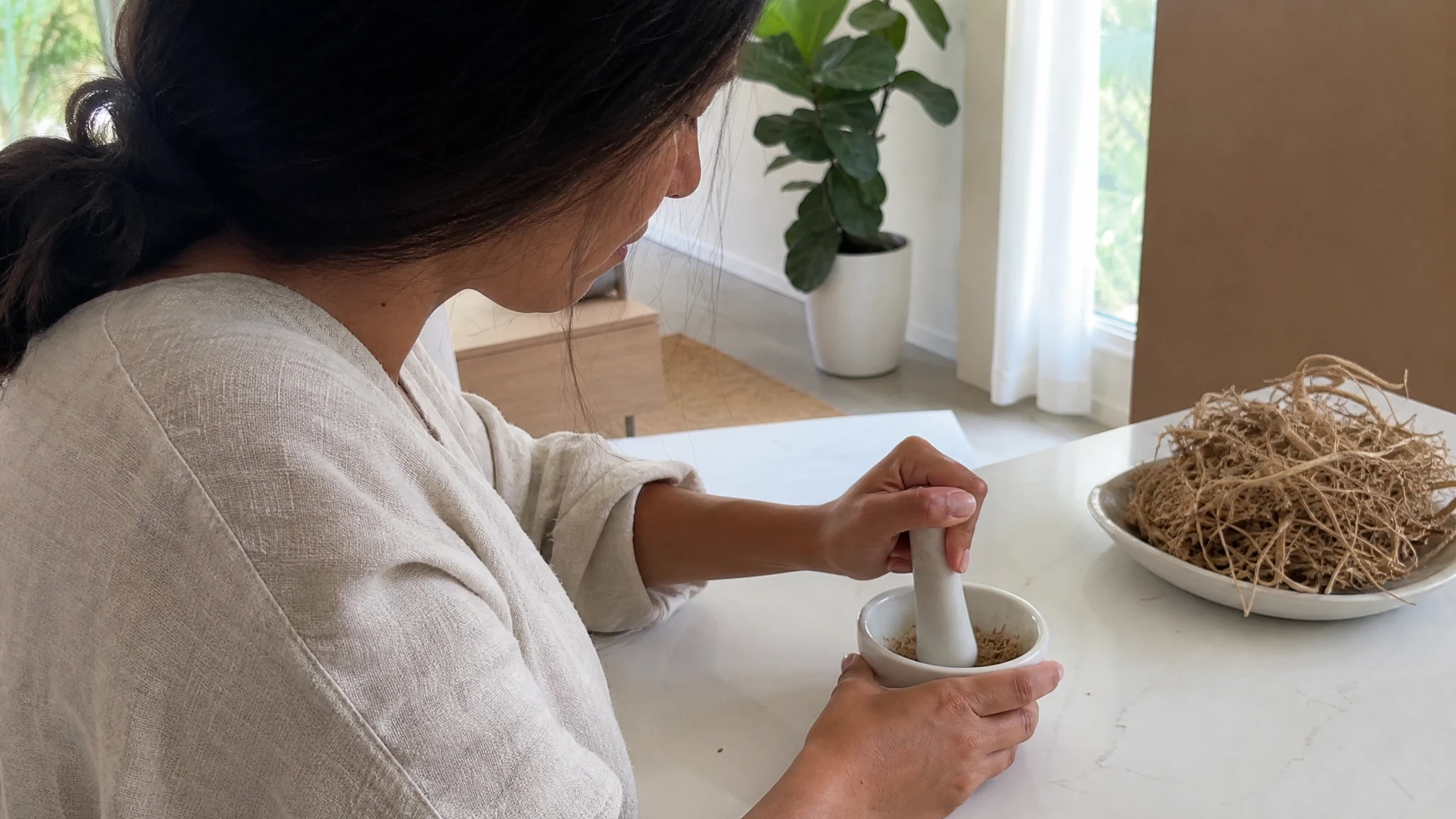
Vetiver Oil Chemistry: What Makes It Smell Like Vetiver
Open a bottle of vetiver and you meet a whole perfume in one drop: a bright grapefruit-like lift, damp earth, something creamy like sandalwood, and a dark, woody-amber base underneath. Chemists have spent decades trying to work out which molecules are behind each of those layers, and the answer is more surprising than you might expect.
Vetiver Essential Oil
Our own Vetiver Essential Oil, in sizes from 0.5 oz to bulk.
From $20.99
Shop Now →Hundreds of ingredients, one aroma
Vetiver is one of the most complex essential oils in the world. A 2021 paper on a Haitian vetiver oil describes it as holding several hundred sesquiterpene derivatives (large, slow-evaporating molecules built from 15 carbon atoms), of which only 155 had been identified at the time. Another team calls it one if not the most complex essential oil produced. So when you read that vetiver contains "over 150 compounds", take that as the number chemists have managed to name so far, not the final count.
That complexity is also why vetiver is so slow to pour, slow to fade on a paper strip, and so useful in perfumery. A crowd of heavy molecules evaporates gradually, and the scent keeps changing over hours.
The loudest molecule is not the one you smell
Here is the part we find most interesting. The compounds that show up as big peaks on a lab chart are not automatically the ones that make the oil smell like vetiver. The 2021 team traced the long-sought woody-amber heart of the scent to a molecule called 2-epi-ziza-6(13)en-3-one, which they made by chemical synthesis to confirm it. Their smelling tests put its odor threshold at 29 picograms per liter of air, which means your nose picks it up at almost unimaginably small amounts.
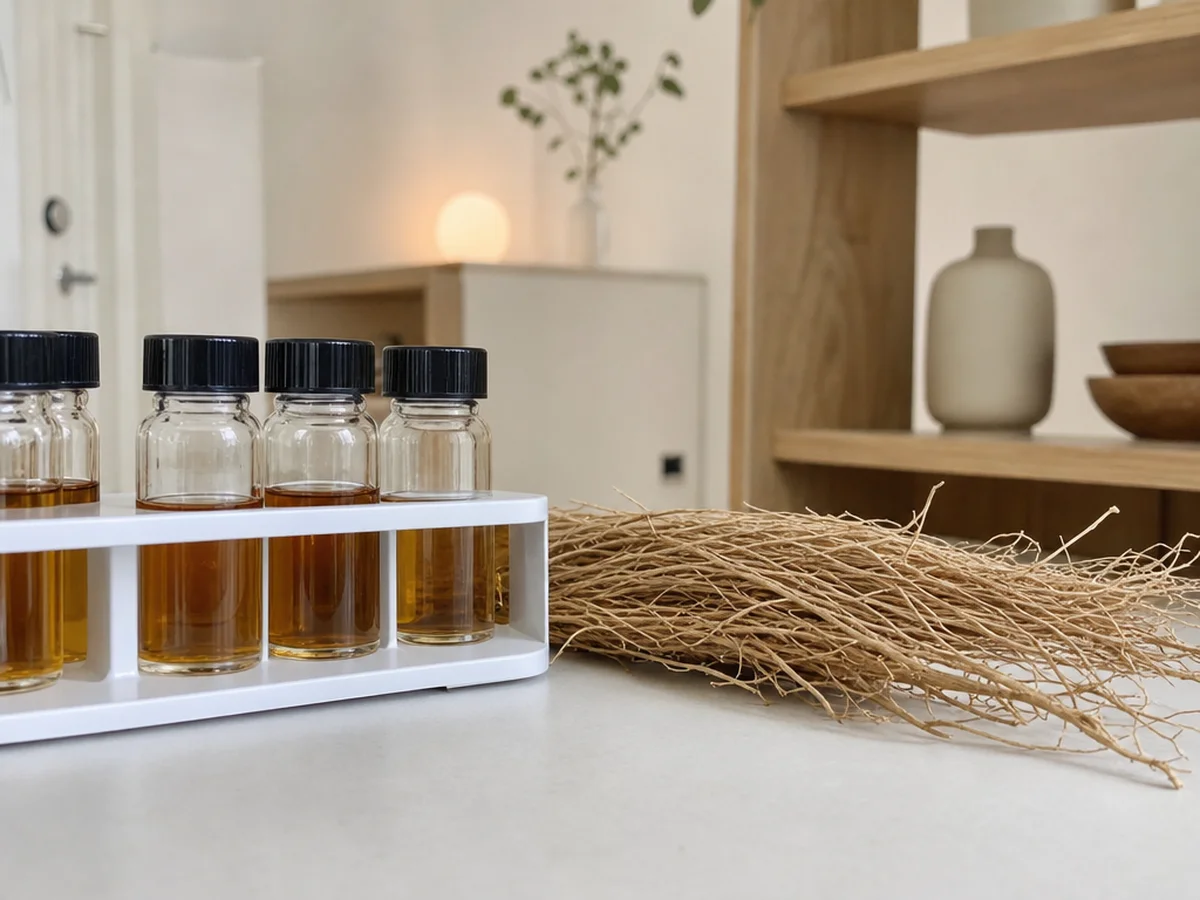
The rest of the picture comes from familiar names. The same paper credits the vetivones and nootkatone for the grapefruit-like top, geosmin for the earthy note, and (E)-isovalencenol for the creamy, cedar and sandalwood-type background. No single molecule on its own smells like vetiver. It takes the whole orchestra.
Why two bottles can smell different
If a few trace molecules carry so much of the character, it makes sense that bottles differ. A 2017 study of three commercial vetiver oils from Réunion found khusimol (one of the best-known vetiver alcohols) ranging from 0.6% in one sample up to 8.9% in another. A perfumer smelling them found that the 0.6% sample had lost some of its typical vetiver character, with weak woody notes. It is only three oils, so treat it as a hint rather than a rule, but it fits the idea that composition and aroma travel together. We cover khusimol and the vetivones in more detail in our piece on the two best-known compounds, and the effect of origin in Haitian, Javanese and Indian vetiver.
Time matters too. A study that stored South Indian vetiver oil for 6 to 30 months saw the oil become more viscous, with the smell moving from green and harsh toward something softer, sweeter and more balsamic. Khusimone and a couple of other compounds rose while khusimol fell. That is one oil from one region, so we would not turn it into a universal rule, but it explains why perfumers talk about vetiver as an oil that rewards patience.
Smelling the layers yourself
You do not need a lab to appreciate the structure. Put a drop of vetiver on a paper strip and smell it straight away. You may catch a bright, citrus-like lift first. After a few minutes the earth comes forward, and later still a quiet, woody sweetness is what remains. That slow shift from top to base is the same one the chemists describe, only you are following it with your nose.
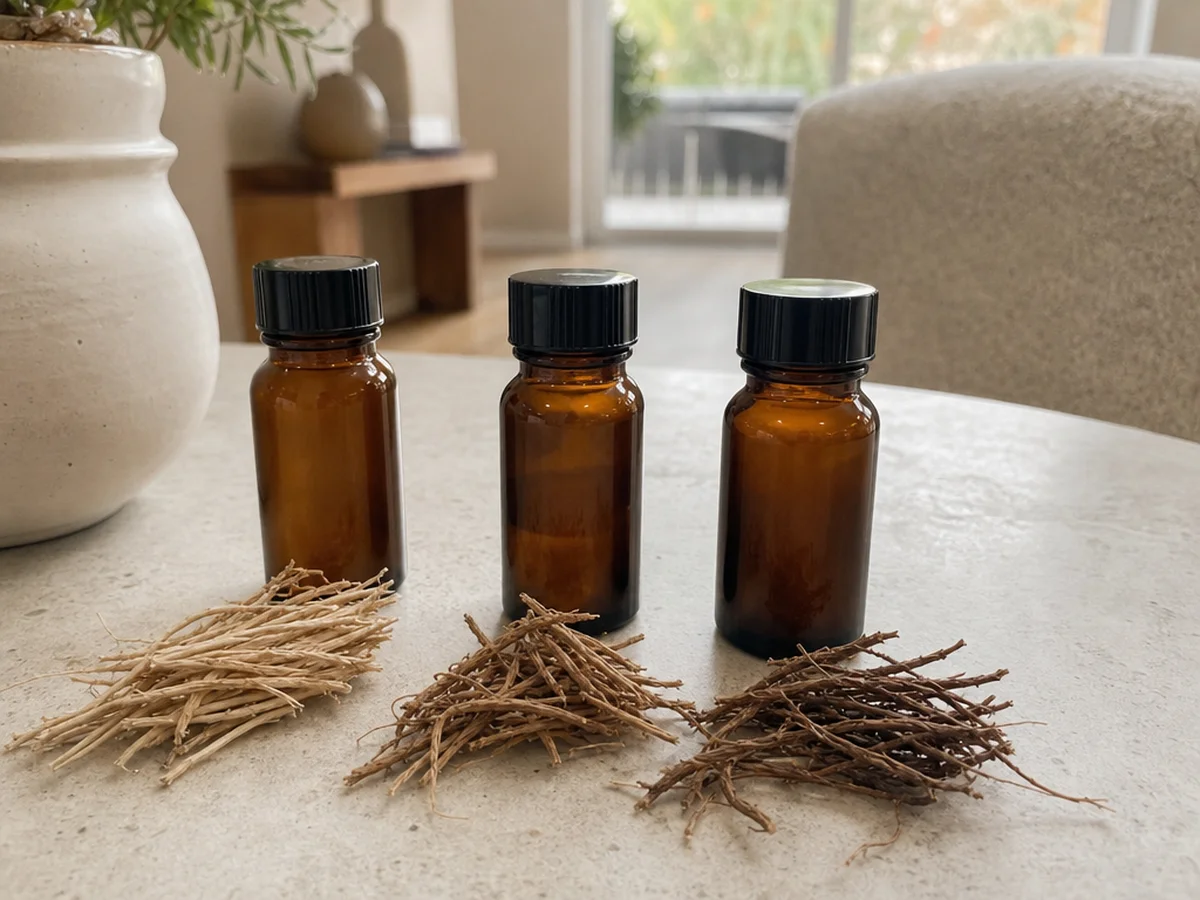
Try describing the smell in your own words and write them down. Words like damp soil, smoke, pencil shavings, grapefruit peel and warm wood all show up when people describe it. There is no wrong answer, and your own list will make it easier to compare one bottle with another.
A note on patience
Because the scent changes so gradually, the best moment to judge vetiver is not the first sniff. Come back to the strip after an hour and again the next day. The oil that seems rough at first can settle into something rounder, and that change is one of its quiet pleasures.
What this means when you shop
For a buyer, the practical lesson is that no one number tells you whether a vetiver oil is the one you want. A single percentage for khusimol, or a long list of peaks, will not reproduce the smell in your hand. Your nose on a paper blotter over a few hours will tell you a lot, and a lot-specific report will tell you the rest.
The Certificate of Analysis we publish covers one batch and lists relative density (0.993 at 20 C) and refractive index (1.525), both inside the ranges printed on the certificate. It does not include a GC-MS breakdown of compounds. If you are a formulator or a perfumer who needs one, ask us in writing through our contact page about the report for your lot and read it before you rely on it. If you would like help judging a bottle by other means, our label-reading guide and our note on soil and climate are good next stops.
It is a lovely thing that a scent this deep comes from a handful of molecules the nose can detect at a whisper, and that chemists are still finding out how it all fits together.
Vetiver Essential Oil
Vetiver Essential Oil from our own shop, in sizes from 0.5 oz to bulk.
From $20.99
Shop Now →Sources & Further Reading
- Ouyang et al., The Smelling Principle of Vetiver Oil, Unveiled by Chemical Synthesis (Angewandte Chemie, 2021)
- Burger et al., Vetiver Essential Oil in Cosmetics: What Is New? (Medicines, 2017)
- Dubey, Chhonkar and Raghav, Effect of Period of Storage on Physico-chemical Properties and Major Constituents of South Indian Vetiver (Vetiveria zizanioides Linn.) Oil (Indian Forester, 2011)